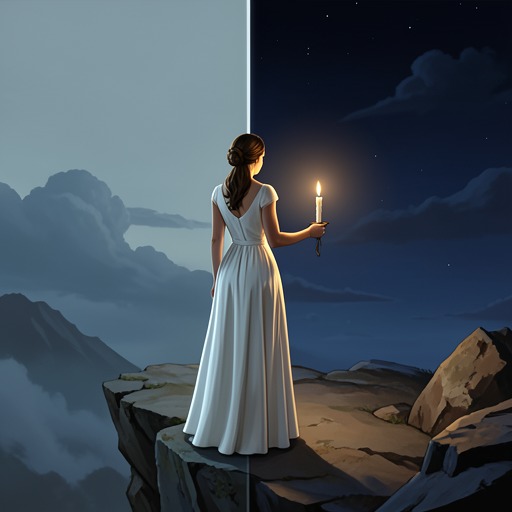
Winter solstice
Under Your Spell: A Romance Boxed Set of Masked Balls, Haunted Gardens, Magic, and MoreWinter solstice functions in Lavinia Lockett Sewall’s story as far more than a date on the calendar. It is first associated with shared knowledge and romantic discovery, then with marriage, bereavement, and the unexplained return of Theodore Sewall, and finally with a material clue that appears to confirm the solstice’s enduring bond with their relationship. Its shortest day and longest night give the narrative a precise seasonal rhythm while also making the solstice a threshold between presence and absence, ordinary time and supernatural possibility.
Definition and First Significance
Winter solstice is introduced through Theodore Sewall’s explanation of the year’s two contrasting turning points. He identifies summer solstice as the longest day and shortest night, then names winter solstice as his other favorite day, describing it as the shortest day and longest night. Lavinia Lockett Sewall already knows the answer and completes his explanation triumphantly. Theodore’s delighted response turns astronomical knowledge into an intimate exchange: the solstice becomes a small test of attention that Lavinia passes, allowing the two characters to share not only affection but a language of seasonal cycles.
The conversation gives winter solstice a double character from the outset. It is objectively measurable, governed by the alignment of stars and planets, yet Theodore also calls it poetic. That combination—cosmic regularity and emotional meaning—prepares the date to carry later events without reducing them to either simple romance or simple supernatural fact. The solstice belongs to the natural world, but the narrative repeatedly makes it feel like a charged interval in which ordinary boundaries may loosen.
Marriage and the Beginning of a Cycle
Lavinia and Theodore marry on the morning of the winter solstice in a small ceremony at Isabelle Lockett Forsythe and Lyle Forsythe’s house outside the village. Lavinia wears a wine-colored wool dress with a pointed bodice and box-pleated skirt, and carries a winter bouquet of yellow witch hazel and red hawthorn berries. Evergreen wreaths decorate the mantel, while Theodore appears in a long gray frock coat, trousers, double-breasted waistcoat, and white cravat. These details place the solstice inside a modest domestic ritual rather than an isolated symbolic tableau: the day joins weather, household decoration, clothing, family, and marriage.
The couple celebrate afterward with a modest lunch at their humble house next door to Isabelle and Lyle. Mr. Mullany, owner of the granite quarry where Lyle and Theodore work, calls to congratulate them, and friends and family gradually leave as the sun begins to set. The movement from public ceremony into gathering darkness gives the day a natural dramatic progression. The marriage begins in daylight, amid witnesses and congratulations, but ends with the couple alone as night arrives.
Their new home is chilly and drafty, with cold air entering through doors, windows, and floorboards, yet its working stove spreads warmth through the small rooms. The house is utilitarian but cozy, decorated with whimsical wallpaper and simple paintings. The setting makes the winter solstice concrete: the season is not merely an emblem of love but a physical condition that the newlyweds must inhabit together. Warmth exists, but it has to be made and maintained against the cold.
The Solstice as Bereavement and Threshold
The same date later becomes the occasion on which Lavinia receives confirmation that the Sweet Lavvy has been lost. On their wedding anniversary, the ship’s stern washes ashore in Boston, and the red letters identifying it establish beyond doubt that the vessel is gone. Theodore’s promised return is placed under the pressure of an apparently final fact. The anniversary therefore collapses two opposing meanings into one day: the winter solstice marks the beginning of Lavinia and Theodore’s married life and the public confirmation of Theodore’s disappearance.
Isabelle delivers the news in Lavinia’s chilly parlor, where a single oil lamp casts a warm, flickering glow against walls and ceiling while the darkness outside expands beyond the lamp’s halo. Lavinia remains blank-faced and unheeding of Isabelle’s tears. She understands that devastation is expected, but she cannot feel or accept Theodore’s death. When Isabelle asks what she is thinking, Lavinia answers that the day is the winter solstice. Her reply does not explain the loss in ordinary terms; instead, it identifies the date itself as the fact that matters.
The solstice thus becomes Lavinia’s defense against linear finality. The shipwreck appears to close Theodore’s story, but the date recalls the earlier conversation in which he associated winter solstice with long night, cosmic alignment, and poetry. In the parlor, the longest night becomes an interval of waiting rather than a simple image of extinction. Lavinia’s calm is not presented as ordinary composure. It is the first sign that she experiences the date as a recurring opening through which Theodore may still return.
The Recounted Solstice Night
When Lavinia later tells Isabelle what happened, she begins by repeating that it was the night of the winter solstice—the very night when news arrived that the stern had washed ashore. She acknowledges that she should have been devastated and knew it at the time, yet she could not believe Theodore was gone. After Isabelle left and Lavinia went upstairs, Theodore was waiting for her in the bedroom. The winter solstice therefore links the external evidence of death with an intimate encounter that contradicts it.
The order of the revelation matters. First comes the ship’s wreckage, then Lavinia’s inexplicable calm, then her recognition of the date, and only afterward her account of Theodore’s presence. The solstice acts as the hinge between public knowledge and private experience. It does not erase the physical evidence surrounding the Sweet Lavvy; rather, it permits the narrative to hold that evidence beside Lavinia’s certainty that Theodore returned.
Because Isabelle listens despite her skepticism, the solstice also becomes the center of an unresolved interpretive problem. Lavinia’s account can be approached as testimony, grief, or a supernatural visitation, but the date gives the experience a recurring structure that ordinary mourning does not fully contain. The winter solstice is the condition under which absence becomes reversible, at least for Lavinia, and the bedroom encounter transforms the date from an anniversary of loss into a possible anniversary of reunion.
Material Memory and Narrative Significance
The solstice’s significance survives Lavinia’s life in an object hidden among her few possessions. After Lavinia takes her final breath, Isabelle prepares to leave her old home and sort through the belongings that had largely remained untouched. In a porcelain jewelry box painted light blue, lined with red velvet, and decorated with a romantic scene of a man offering a woman red flowers, Isabelle finds Lavinia’s inherited jewelry: pearl earrings, a gold necklace, and a peacock brooch set with a ruby and an emerald.
Among these objects is a simple gold locket watch fob that Isabelle has not seen since before Theodore went to sea. Its engraving reads, “TS + LL, winter solstice ’56.” The inscription gives the date a physical counterpart and makes the solstice part of the couple’s private history before the ship’s disappearance. It also deepens the uncertainty surrounding Lavinia’s account: the date was not merely imposed on the story by later grief, but had already been marked as meaningful in an object connected to both Theodore and Lavinia.
The watch fob turns seasonal recurrence into material evidence. The solstice appears first in spoken conversation, next in the marriage ceremony, then in the anniversary of the Sweet Lavvy’s loss, and finally in an engraved keepsake recovered after Lavinia’s death. Across these appearances, it gathers meanings without becoming fully explainable. It is a point of recurrence where love, memory, death, and possible return meet. The narrative’s winter imagery therefore does not simply symbolize sorrow; it creates a threshold in which the shortest day and longest night hold open the possibility that an ending may also be a concealed continuation.